
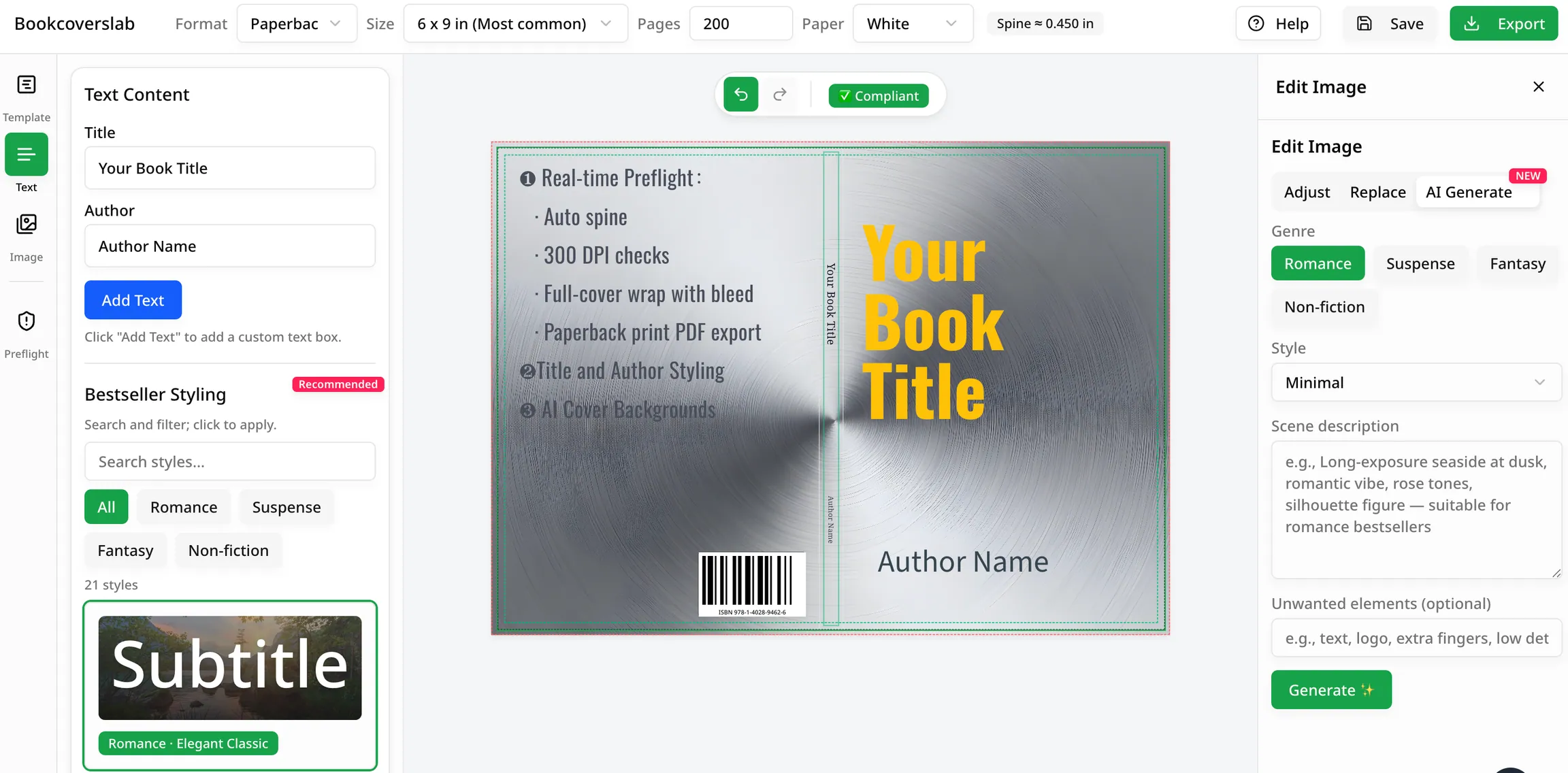
AI Romance Book Cover Prompts That Fit Your Subgenre
If you need a fast answer, here it is: the best AI romance book cover prompts do not start with “make me a romance cover.” They start with the exact shelf promise you want readers to feel in one second.
That promise usually comes from four variables:
- Subgenre: contemporary, dark romance, historical, paranormal, romcom, billionaire, small-town, and so on
- Heat level: sweet, medium spice, high heat, dangerous obsession
- Scene type: intimate close-up, symbolic mood piece, glamorous location, supernatural setting
- Thumbnail clarity: enough focal structure that title treatment can still work later
The reason this matters is simple. Romance readers are fast pattern-matchers. They do not need a full explanation. They need a cover that feels right.
If you want to test those directions directly, start with the AI Romance Book Cover Generator. If you want the broader tool first, you can also use the main AI Book Cover Generator and compare romance against other genre directions.
Why most AI romance prompts underperform
Most weak prompts fail in one of three ways:
- They are too broad, so the output looks like generic women’s fiction or fantasy art.
- They describe appearance but not emotional tension.
- They create a pretty image with no room for title hierarchy later.
That is why “beautiful romantic couple, book cover, high quality” rarely gives you a market-ready direction. It does not tell the model whether the book is cozy and hopeful, dark and obsessive, elegant and historical, or magical and fated.
For romance, visual specificity matters more than verbal poetry.
The short formula for stronger AI romance book cover prompts
Use this structure:
[Subgenre] + [emotional tension] + [setting] + [palette / light] + [composition intent] + “no text”
Example:
small-town contemporary romance, gentle longing, seaside bakery at sunrise, blush and cream palette, clean front-cover composition with room for title, no text
That formula gives you much more control than a generic “romance book cover” prompt because it tells the image model:
- what kind of romance this is
- how intense the relationship energy should feel
- what visual world the reader expects
- how to leave space for the final publishing workflow
AI romance book cover prompts by subgenre
Contemporary romance
Use contemporary prompts when the book promise is emotional closeness, relatability, lifestyle aspiration, or warm chemistry.
Prompt example
contemporary romance book cover, elegant city rooftop at sunset, intimate eye contact, champagne glow, rose and gold palette, premium but emotionally warm, clean composition, no text
What this works for
- billionaire romance
- workplace romance
- second-chance romance
- celebrity romance
Best visual signals
- warm natural light
- clean fashion-forward styling
- clear relationship energy
- modern environments that do not overpower the couple dynamic
Dark romance
Dark romance needs a different emotional promise. The image should imply danger, obsession, secrecy, power imbalance, or forbidden attraction.
Prompt example
dark romance cover art, luxury penthouse at midnight, intense chemistry, black velvet and crimson palette, dramatic shadows, dangerous elegant atmosphere, cinematic front-cover composition, no text
What this works for
- forbidden romance
- mafia romance
- morally gray hero stories
- obsessive antihero dynamics
Best visual signals
- black, crimson, wine, or metallic contrast
- hard light and shadow
- expensive settings or dangerous environments
- more intensity than softness
Historical romance
Historical romance covers still sell atmosphere fast. Readers want to know the story lives in a different world before they process the plot.
Prompt example
historical romance book cover, regency ballroom under candlelight, embroidered gown, restrained longing, ivory and gold palette, elegant composition with room for serif title, no text
What this works for
- regency romance
- victorian romance
- aristocratic romance
- arranged marriage and courtship stories
Best visual signals
- candlelight
- ornate textures
- gowns, uniforms, jewelry, estates
- elegance first, danger second
Paranormal romance
Paranormal romance succeeds when the prompt keeps the romance and the supernatural in balance. If the magic dominates, the result can drift into straight fantasy. If the chemistry dominates without worldbuilding cues, the result can drift into generic romance.
Prompt example
paranormal romance cover image, moonlit forest clearing, glowing runes, fated-mates tension, silver-blue magical light, sensual but mystical atmosphere, front-cover composition, no text
What this works for
- vampire romance
- wolf shifter romance
- witch romance
- fae romance
- magical bond stories
Best visual signals
- moonlight and glow effects
- symbols, claws, wings, or supernatural motifs
- blue-violet, silver, midnight palettes
- visible chemistry, not just fantasy spectacle
How to control heat level without breaking genre fit
One useful trick is to change only the emotional intensity and keep the rest of the prompt stable.
Here is a simple guide:
| Heat level | Prompt language to emphasize | Visual result you usually want |
|---|---|---|
| Sweet / closed-door | tender, warm, hopeful, soft, playful | brighter palette, safer body language, more approachable mood |
| Medium spice | longing, charged, intimate, magnetic | stronger chemistry, a little more contrast, still emotionally open |
| High heat / dark | obsessive, dangerous, intense, forbidden | more shadow, richer palette, heightened body language, sharper tension |
This is especially useful if you write in romance categories where the reader expectation is precise. A high-heat dark romance should not look like a bakery romcom, and a gentle small-town romance should not look like a mafia thriller with kissing.
Prompt details that usually improve AI romance cover results
If your early outputs still feel off, improve these parts of the prompt:
- Add relationship energy: longing, tension, playfulness, forbidden desire, emotional safety
- Add a scene anchor: ballroom, bookstore, snowy forest, penthouse, vineyard, seaside cliff
- Add a palette: blush, rose-gold, crimson-black, ivory-gold, silver-blue
- Add composition intent: front-cover composition, clean title space, vertical 2:3, no text
- Add shelf intent: romance bestseller mood, premium romance cover image, emotionally immediate
The last piece matters. You are not asking the model to make an illustration. You are asking it to suggest a sellable book-cover direction.
What to do after the prompt works
Even great AI romance book cover prompts only solve the concept problem. They do not solve the final publishing problem.
After you have the right concept:
- Keep the version that best matches the subgenre promise.
- Rebuild the final cover with typography that fits romance conventions.
- Make sure the focal point still works with title placement.
- Finish the paperback or hardcover geometry in a production workflow.
That last step is where many authors lose time. The image may look finished, but the file still needs trim, bleed, spine logic, and back-cover layout. When you are ready for that part, move the chosen concept into the KDP Cover Creator so the romance image and the final print layout stay aligned.
A simple workflow you can reuse on every romance title
If you do not want to overthink every book, this sequence works well:
- Start with one subgenre and one heat level.
- Generate 3 to 6 prompt variations around that exact promise.
- Throw out anything that looks beautiful but emotionally wrong.
- Keep the direction that reads correctly even as a tiny Amazon thumbnail.
- Finish the final cover only after the visual promise is stable.
That is also the best reason to use a dedicated AI Romance Book Cover Generator instead of a generic prompt playground. It shortens the time between “I have an idea” and “I know which romance direction actually fits this book.”
FAQ
Are AI romance book cover prompts enough to make a final KDP cover?
Not by themselves. They are strong for concept generation, but the final cover still needs typography, trim logic, spine handling, and export setup.
Should I use character faces or symbolic romance imagery?
That depends on your subgenre and market. Some categories respond well to direct chemistry and character energy. Others work better with symbolic luxury, mood, or atmosphere. The right answer is whichever signal your readers recognize fastest.
How many prompts should I test?
Usually 3 to 6 good prompt variations is enough. More than that often creates noise instead of clarity.
What matters more: the prompt or the final title treatment?
Both matter, but title treatment is where many romance covers stop looking professional. The prompt chooses the emotional direction. Typography finishes the market signal.
Related Resources
- AI Romance Book Cover Generator
- AI Book Cover Generator
- KDP Cover Creator
- AI Book Title Generator
- KDP Book Size Calculator
Conclusion
The best AI romance book cover prompts are not the most elaborate. They are the ones that tell the model exactly what kind of romantic promise the book should make.
Start with subgenre, control the heat level, choose a scene that readers recognize, and leave room for the final title treatment. If you do that, AI becomes much more useful as a romance cover ideation partner instead of a random image machine.
Author

Categories
More Posts
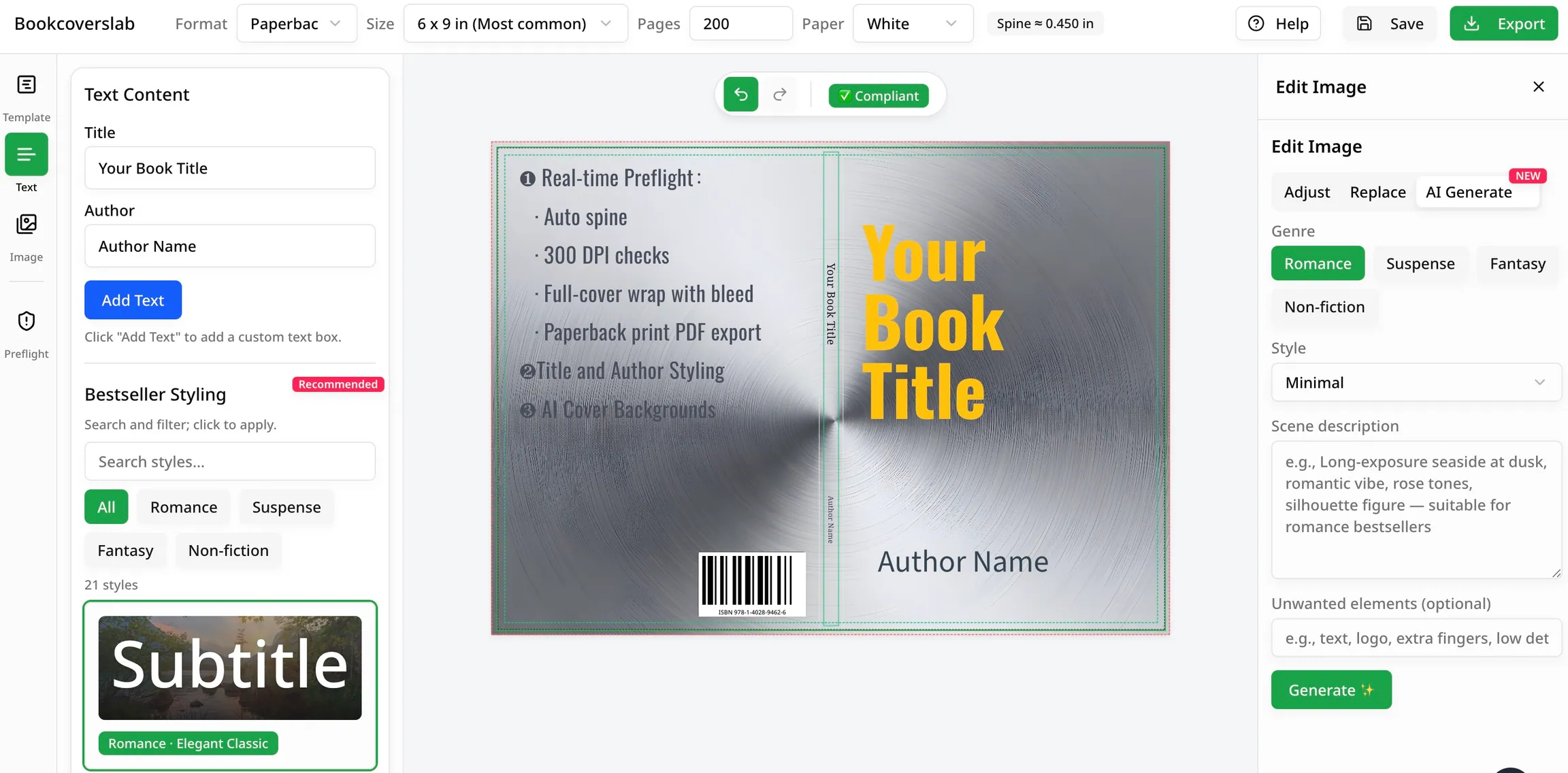
Book Cover Typography: 7 Rules for Titles That Get Noticed
Master book cover typography with practical rules for font choice, hierarchy, genre fit, thumbnail readability, pairing, and crisp KDP print export.
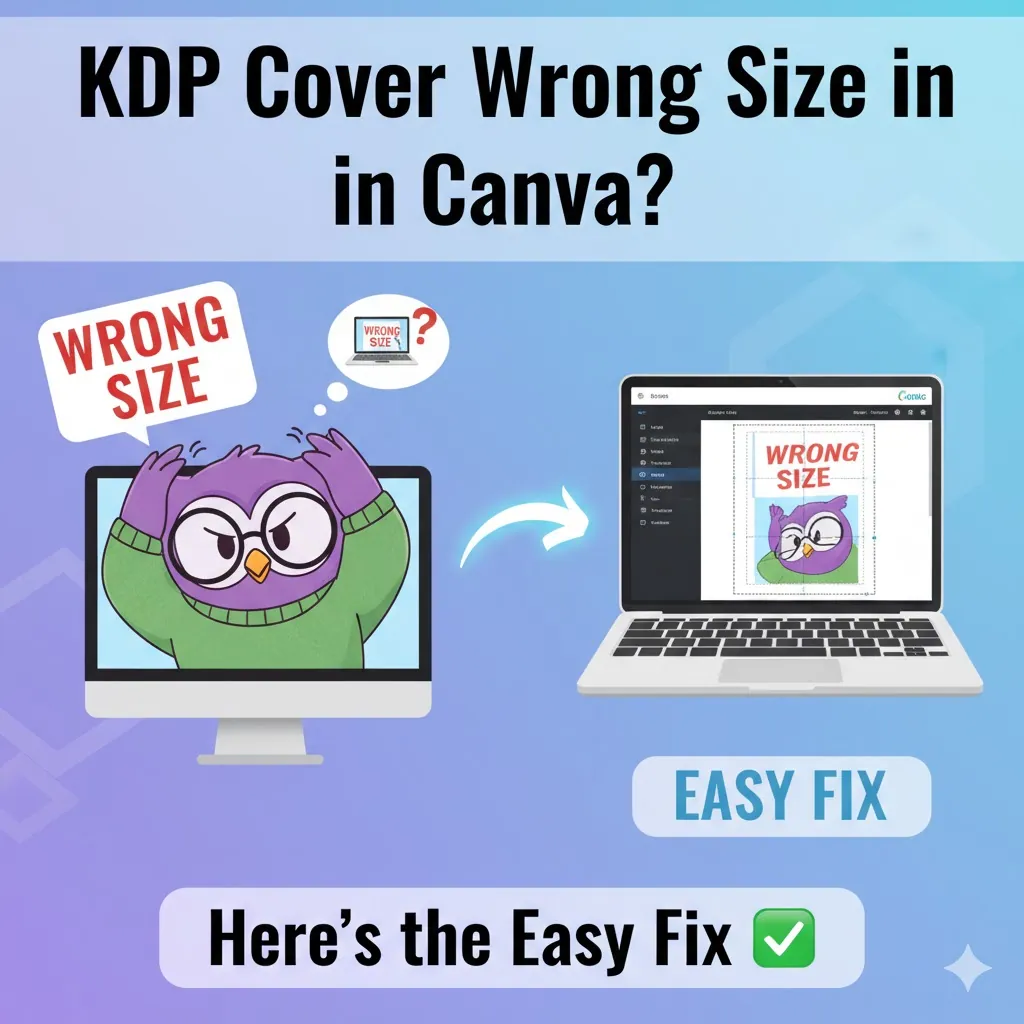
KDP Cover Wrong Size in Canva? Here’s the Easy Fix
KDP rejection errors? Learn why your Canva book cover keeps coming in wrong size for KDP (it's the spine and bleed!) and discover the easy, error-proof fix.
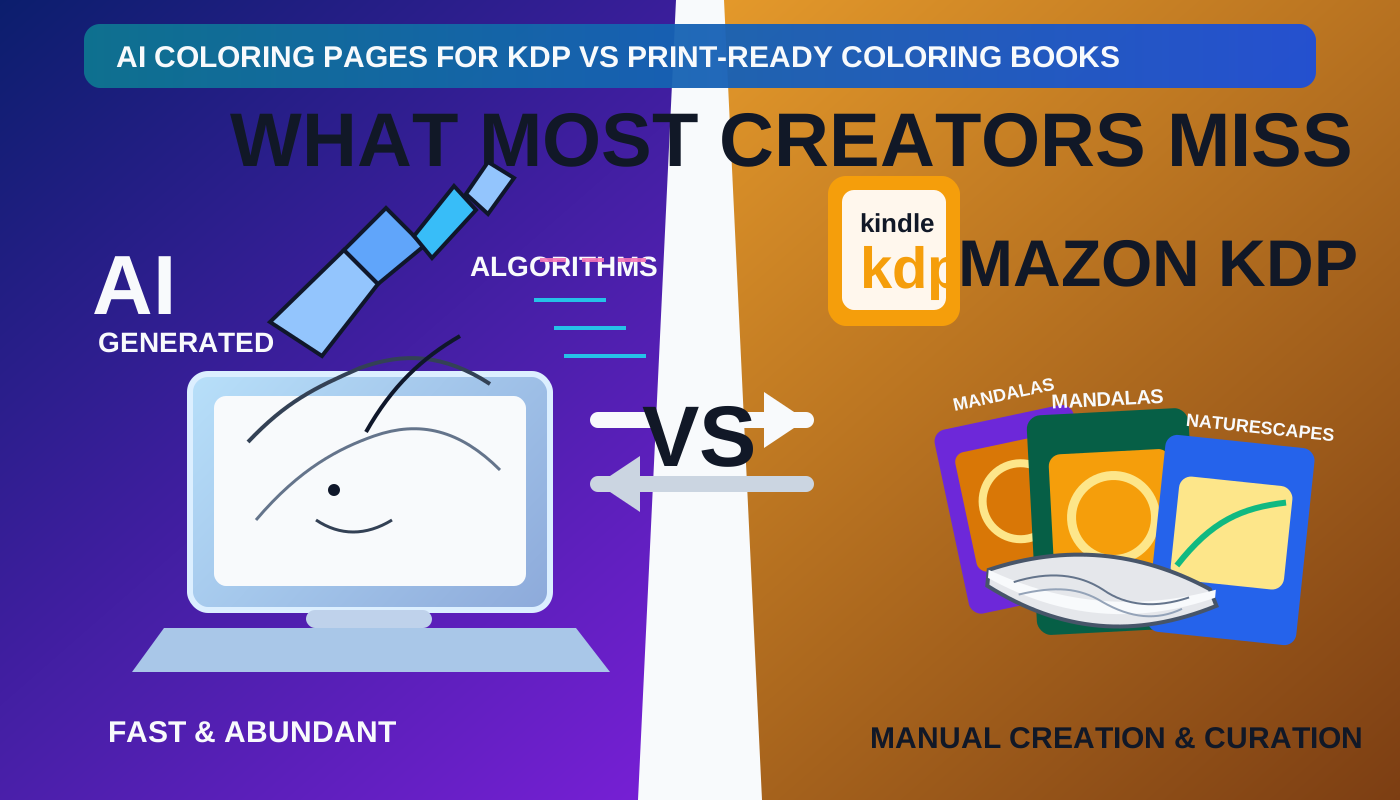
AI Coloring Pages for KDP vs Print-Ready Coloring Books: What Most Creators Miss
AI coloring pages are not the same as a print-ready KDP coloring book. Learn the difference between generating pages and shipping a complete interior, cover, and upload-ready package.
Newsletter
Join the community
Subscribe to our newsletter for the latest news and updates